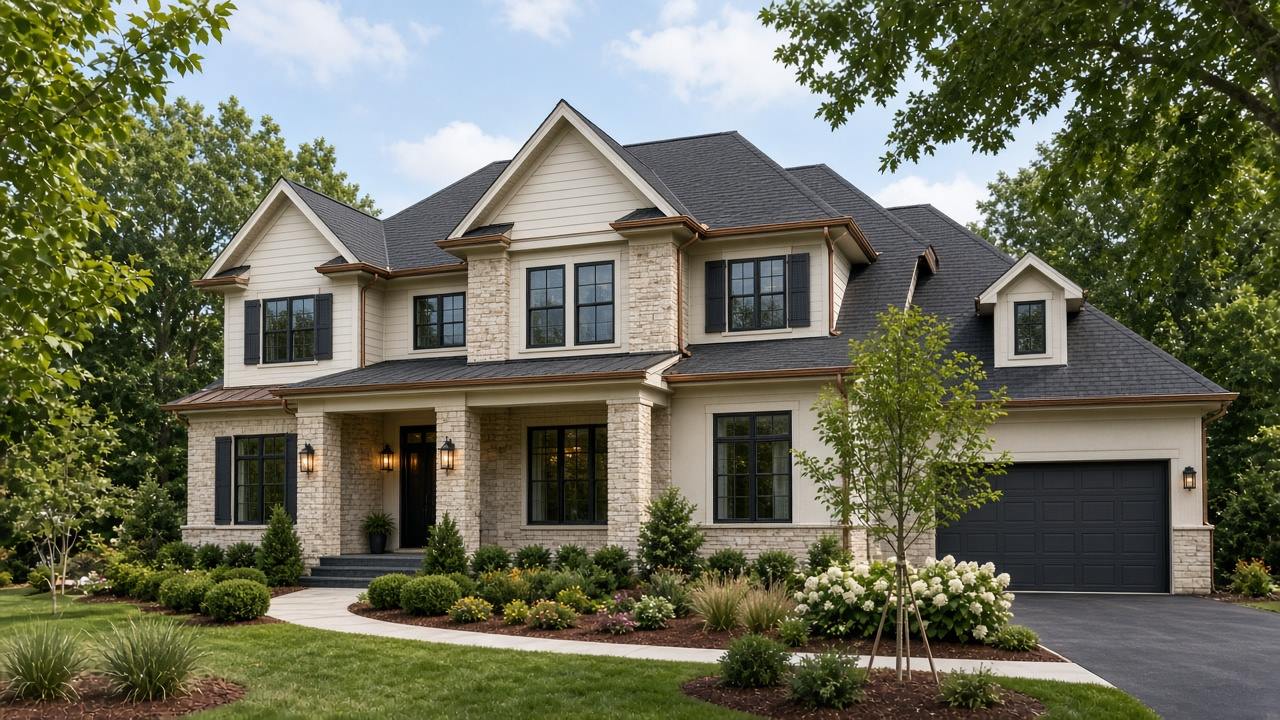
Residential roofing services cover the roofs people sleep under. The searches are broad: residential roofing, residential roof repair, residential roof replacement, and residential roof installation. They share a building type and diverge in scope. A house with one open flashing is not a house that needs every slope removed. This page is the house overview. The scope you need is linked, not repeated as a second full guide.
Business roofs, even small ones, are planned as commercial roofing when the system is a membrane or the building is occupied by a tenant operation. If you have both a house and a shop, tell us. They will not share one casual scope.
How house roofs differ
Pitch changes everything. A walkable 5/12 and a steep 12/12 are different safety plans and different labor. Dormers, dead valleys, and chimneys add flashings that a simple gable never sees. Attics show the truth of a leak if they can be entered. Bedrooms directly under a valley need interior protection when that valley is opened. None of that appears in a price-per-square screenshot.
Weight matters when the conversation turns to tile or slate. A house that has carried asphalt can often carry asphalt again. It cannot automatically carry concrete tile. We do not switch systems because a photo looked good. Structural questions are named before an order is placed. The material pages are shingle roofing, metal roofing, and tile roofing.
Repair, replacement, and installation on a home
Residential roof repair stays local: boots, valleys, walls, and limited deck damage on a covering that still has life. Residential roof replacement is the tear-off when the field is done. Residential roof installation is the assembly itself, including ventilation and flashing, whether the deck is new or newly exposed. Leak-specific tracing is roof leak repair, which matters in houses because stains travel along rafters into the wrong room.
During the work, expect a dumpster or a trailer, protected beds where we can protect them, and a dry-in before the crew leaves an opened slope. You should not have to guess which day the roof is only underlayment. That day is part of the schedule we discuss.
Edges, skylights, and weather
House leaks often start at the edge rather than the field. Kickout flashing that dumps water behind siding, rotten fascia, and a gutter full of granules are house problems. They are handled with soffit and fascia repair when the perimeter is the failure. Skylights over stairs and baths are skylight details. Wind and hail have their own documentation so a maintenance item is not dressed up as a storm, and a real storm is not ignored.
What changes a house proposal
- Stories and pitch
- Height and steepness drive setup more than the brand of shingle.
- Cut-up roofs
- Dormers and valleys add metal and time a rectangle does not have.
- Layers
- A second layer of shingles hides the deck and adds tear-off.
- Living in the house
- Interior protection and daily dry-in are part of a home project.
We take residential work in Denver, Colorado and surrounding areas. Ask for a roof inspection if you are buying the house and need condition before you inherit someone else’s patches. Ongoing care after a sound roof is in place is maintenance.
Living in the house while the roof is open
Most families stay home. The practical plan is which rooms sit under the slope being torn off, where the dumpster sits so it does not block the only driveway, and how pets are kept off the work zone. Interior protection is plastic and a clear floor under valleys and chimneys, not a promise that dust will be zero. If a bathroom fan terminates in the attic instead of through the roof, we will say so. That fan is wetting the deck from the inside and will stain a new roof’s story if nobody mentions it.
Children, solar mounts, and dish hardware need a decision before the first shingle comes off. Abandoned holes are closed with deck and underlayment. Hardware you still use is reflashed, not buried. If a roofline addition was framed years ago and the tie-in flashing was a smear of sealant, the residential scope includes that wall. Leaving it because it was “not the main roof” is how the new field stays dry and the addition does not. Ask for that wall as a line item if you already know it leaks in wind.
After the crew leaves, walk the beds for nails, run water in the gutters if they were reset, and look in the attic once more on the next hard rain. A single drip then is information, not a failed philosophy. Call while the detail is wet. Waiting a season turns a flashing adjustment into a guess. That follow-up is part of caring for a shingle, metal, or tile house, and it is cheaper than starting over.
House roof questions
Can we stay in the house during replacement?
Usually, yes, with noise and with rooms under the open slope protected. If a deck is unsafe, we will say which areas to avoid.
Which material should a house use?
Match pitch, weight, and the details you already have. Shingles, metal, and tile are compared on their own pages, then priced on the same scope.
Do you repair older roofs?
Yes, when the field still has life. If it does not, we will say replacement is the honest spend.
What about a detached garage?
It can be included. It is still its own slope, its own flashing, and sometimes a different pitch. It should be a line in the scope, not a verbal extra.
How do I start a residential roofing request?
Use contact and tell us stories, roof type, and whether water is coming inside. Service geography is confirmed on the service areas page.
Will you claim the house in the photo is your project?
No. Photography on this site is illustrative of roof conditions and finished systems, not a fake address list.